1960 Hypertext
Conventional wisdom has it that the Internet started off as an American defence and educational network, then Tim Berners-Lee came along and invented the World Wide Web and the rest is history.
But there's another, far more obscure figure, who can be credited with originating the idea of 'hypertext' long before it was ever applied to the Internet. As far back as 1960, Theodore H (Ted) Nelson was developing an idea for an interconnected network of documents with embedded links to each other. In 1963 he chose the word 'hypertext' to describe the system, publishing his theories in 1965's groundbreaking paper, "A File Structure for the complex, the changing and the Intermediate" for the Association for Computing Machinery's (ACM's) national conference. By 1967 he'd chosen the name Xanadu for his hypertext project, from Coleridge's poem about Kublai Khan.
While the Xanadu project itself has so far not come to fruition as a real working system, the ideas directly inspired Tim Berners-Lee's World Wide Web, Ray Ozzie's Lotus Notes, and Bill Atkinson's HyperCard (the first multimedia system). By inventing the idea of hypertext, Ted Nelson was the under praised architect of some of the most influential new information structures in the history of computing. More information can be found here>>
top>>
1960 Open Source
Throughout the 1960's and 1970's golden age of computing, open source software, largely funded by the US government, was the wellspring of creation for the programming industries.
Through a combination of key funding agencies, administrative oversight of software standards and government purchasing rules, the US helped stimulate open source software and open standards for decades.
Until Microsoft's DOS and Windows, almost the entire software market was based on sharing and open source.
Bill Gates has never liked the concept and in 1976, at the age of 21, asked in an angry letter to open source programmers: 'One thing you do is prevent good software from being written. Who can afford to do professional work for nothing?'
Open Source faded into the background until its re-emergence with Linux at the forefront.
top>>
1961 the first electronic spreadsheet
In the realm of accounting jargon a "spread sheet" or
spreadsheet was and is a large sheet of paper with columns and rows that lays
everything out about transactions for a business person to examine. It spreads
or shows all of the costs, income, taxes, etc. on a single sheet of paper for a
manager to look at when making a decision.
An electronic spreadsheet organizes information into software
defined columns and rows. The data can then be "added up" by a formula to give a
total or sum. The spreadsheet program summarizes information from many paper
sources in one place and presents the information in a format to help a decision
maker see the financial "big picture" for the company.
Beginnings and the "Tale of VisiCalc"
In 1961, Professor Richard Mattessich pioneered the development
of computerized spreadsheets for use in business accounting. Some historical
information on the computerization of accounting spread sheets using mainframe
computers is discussed on Mattessich's page
"Spreadsheet: Its First
Computerization (1961-1964)".
Mattessich's work and that of other developers
of spreadsheets on mainframe computers probably had no influence on Bricklin and
Frankston who later developed VisiCalc.
top>>
1962 The first commercial Modem
In 1962, the first commercial modem was
manufactured - the Bell 103 by AT&T. The Bell 103 was also the first modem
with full-duplex transmission, frequency-shift keying or FSK, and had a speed of
300 bits per second or 300 bauds.
See more detail here>> and visit
A History
of the Modem here>>.
top>>
1963 The first Mouse
Years before personal computers and desktop information processing became commonplace or even
practicable, Douglas Engelbart had invented a number of interactive, user-friendly information access
systems that we take for granted today: the computer mouse, windows, shared-screen teleconferencing,
hypermedia, groupware, and more.
At the Fall Joint Computer Conference in San Francisco in 1968, Engelbart astonished his colleagues by
demonstrating the aforementioned systems---using an utterly primitive 192 kilobyte mainframe computer
located 25 miles away! Engelbart has earned nearly two dozen patents, the most memorable being
perhaps for his "X-Y Position Indicator for a Display System": the prototype of the computer "mouse"
whose convenience has revolutionized personal computing.
1964 Basic
Visual Basic is often taught as a first programming language today as it is based on the BASIC language developed in 1964 by John Kemeny and Thomas Kurtz. BASIC is a very limited language and was designed for non-computer science people. Statements are chiefly run sequentially, but program control can change based on IF..THEN, and GOSUB statements which execute a certain block of code and then return to the original point in the program's flow. More on Programming languages here>>
top>>
1965 Moore's Law
In April 1965, three years before Intel was founded, Dr Gordon Moore
noticed that microchip capacity seemed to double every 18 to 24 months. This
rate of increase later became known as Moore's Law.
He published a paper in electronics entitled "Cramming more components
onto integrated circuits". In this paper, written when an Integrated Circuit contained fewer than one hundred transistors,
Moore made the now- famous prediction that ten years later there would be 65,000 components on a
single silicon chip, equating to a doubling of transistor density every year.
Remarkably, this prediction held true and the law, now revised to the more popular 'processor clock speeds
double every 18 months', has been one of the factors driving development in the industry.
Some see it almost as a self-fulfilling prophecy -the law sets the timetable for where manufactures
must be if they are to compete. So, if in a year Moore's Law says there should be a 700MHz chip,
then in a year's time, that's what you must have.
What is the future of Moore's Law? Andy Groove, former Intel CEO, predicted
that Intel will ship a processor with one billion transistors in 2011 which
is in line with Moore's Law. Other industry experts see silicon technology
reaching its physical limits around 2017. The implications of the continued
viability of Moore's Law are profound. In addition to the fact that our
increasingly computerized economy will become even more productive, other
technologies such as voice recognition, virtual reality, and artificial
intelligence begin to appear possible. And speaking of profound, if Moore's
Law were to somehow survive on into 2030, the processor would then surpass
the computational power of the human brain.
Chart here>>
top>>
1969 Arpenet and the Internet
heralds the birth of the Internet. The Internet was first conceived in the early '60s. Under the leadership of
the Department of Defence's Advanced Research Project Agency (ARPA), it grew
from a paper architecture into a small network (ARPANET) intended to promote the
sharing of super-computers amongst researchers in the United States. In 1969 ARPANET connected the first universities in the United States.
Researchers at four US campuses created the first hosts of the ARPANET, connecting Stanford Research Institute,
UCLA, UC Santa Barbara, and the University of Utah.
ARPANET was a success from the very beginning. Although originally designed to allow scientists to share
data and access remote computers, email quickly became the most popular application.
ARPANET became a high-speed digital post office as people used it to collaborate on research projects and
discuss topics of various interests. The Inter-Networking Working Group becomes the first of several
standards-setting entities to govern the growing network in 1972. Vinton Cerf was elected the first chairman
of the INWG, and later became known as a "Father of the Internet." An in-depth
history of the internet is here>>
courtesy of About the web.com.
Another great link for details on how the web was won can be found at
"The Lemon" here>>
top>>
1971 Wireless Lan
The history of wireless networking stretches farther back than
you might think. It was over fifty years ago, during World War II, when the
United States Army first used radio signals for data transmission. They
developed a radio data transmission technology, which was heavily encrypted. It
was used quite extensively throughout the campaign with the US and her allies.
This inspired a group of researchers in 1971 at the University of Hawaii to
create the first packet based radio communications network. ALOHNET, as it was
named, was essentially the very first wireless local area network (WLAN). This
first WLAN consisted of 7 computers that communicated in a bi-directional star
topology (see http://www.its.bldrdoc.gov/fs-1037/ and http://www.webopedia.com/ -- both are excellent
sources of computer and telecommunication terms and definitions) that spanned
four of the Hawaiian Islands, with the central computer based on Oahu Island.
With this, wireless networking was born.
Thanks to Toms Hardware for the full
story
top>>
1971 The first e-mail
Sometime in late 1971, a computer engineer named Ray Tomlinson sent the first
e-mail message. "I sent a number of test messages to myself from one machine to
the other," he recalls now. "The test messages were entirely forgettable. . . .
Most likely the first message was QWERTYIOP or something similar."
see full article here>>
Top>>
1971 Intel is born.
The first Micro -processor, The 4004, is designed by Intel's Marcian Hoff. The breakthrough 4004
"a computer on a chip" marked Intel's first foray into the logic front, triggering the Information
Technology revolution.
Invented by Intel, the 4 bit sillicon chip packed as much processing power as the first electronic computer
- the 3,000 cubic foot ENIAC, into a space smaller than a thumbnail.
The 4004, which had 2300 MOS transistors, unleashed creativity and innovation by making affordable
computing power available to designers of all types of products.
More information can be found on
Intel's own history site here>>
top>>
1972 C programming language.
C was developed in 1972 by Dennis Ritchie while working at Bell Labs in New
Jersey. The transition in usage from the first major languages to the major
languages of today occurred with the transition between Pascal and C. Its direct
ancestors are B and BCPL, but its similarities to Pascal are quite obvious. All
of the features of Pascal, including the new ones such as the CASE statement are
available in C. C uses pointers extensively and was built to be fast and
powerful at the expense of being hard to read. But because it fixed most of the
mistakes Pascal had, it won over former-Pascal users quite rapidly.
More on Programming languages here>>
1972 Pong
 Pong is widely regarded as the first commercially available computer game and while that's not
strictly true, it was the game that launched a thousand misspent youths. The game -two-dimensional
tennis -is generally accredited to Atari, which first marketed the low-spec two-player game in 1972,
but an even earlier version of the game was programmed by Willie
Pong is widely regarded as the first commercially available computer game and while that's not
strictly true, it was the game that launched a thousand misspent youths. The game -two-dimensional
tennis -is generally accredited to Atari, which first marketed the low-spec two-player game in 1972,
but an even earlier version of the game was programmed by Willie Higinbotham.
The designer created an interactive tennis game on an oscilloscope back in 1967, five years before
Atari came into being.
In 1971, Nolan Bushnell and Ted Dabney invented Computer Space, a basic shoot-em-up, and it flopped.
Undaunted, the pair -along with Al Alcorn -formed a company called Syzygy, and designed Pong.
They renamed the company Atari and put Pong on sale in November 1972 -the rest is gaming history.
With 100,000 units Pong turned out to be the biggest- selling video game ever, only
rivalled by
the next milestone: PacMan.
top>>
1972
Xerox begin work on GUI interface
Xerox begin development of the GUI (Graphics User Interface) based
system, known as the Alto, and later The Xerox Star. This GUI designed
by Xerox was the cornerstone of Windows and Apple.
top>>
1972 Ethernet Networking
The first experimental Ethernet system, the Alto Aloha Network,
 was developed by Dr Robert M Metcalfe at
Xerox PARC. He came up with three rules to allow computers to share data
across a single line:
was developed by Dr Robert M Metcalfe at
Xerox PARC. He came up with three rules to allow computers to share data
across a single line:
1)wait for a break in traffic before sending;
2)give each
computer equal rights;
3)when two try to send at the same time, each should
pause and retry at random intervals.
It was designed to interconnect a selection of Xerox Altos,
personal workstations with a graphical user interface. It also linked them to servers and laser printers. The data transmission rate was 2.94 Mbits/sec.
Metcalfe then wrote his dissertation on a reworked model of Aloha net, which he called
Ethernet. Xerox (as with the GUI) did not patent the idea so it became an
open standard.
In 1973, this became Ethernet. He'd changed the name from Aloha net to indicate that the system
was capable of supporting any computer (not just Altos), and had evolved beyond the original Aloha system.
He chose to base the name on the word 'ether', the mysterious fifth element that Greek philosophers thought
filled the heavens. Later, in the 19th century, 'ether' was used as a name for the medium which was
thought to carry electromagnetic and gravitational waves. In a similar way, the Ethernet medium
(for example, a cable) carries bits to all stations.
Ethernet was patented #4063220 on 13 December 1977 by Metcalfe, who went on to found 3Com in June 1979
and made a fortune not from Ethernet itself but more from the adaptors
implementing it. Since then, Ethernet has become the de facto business networking standard.
top>>
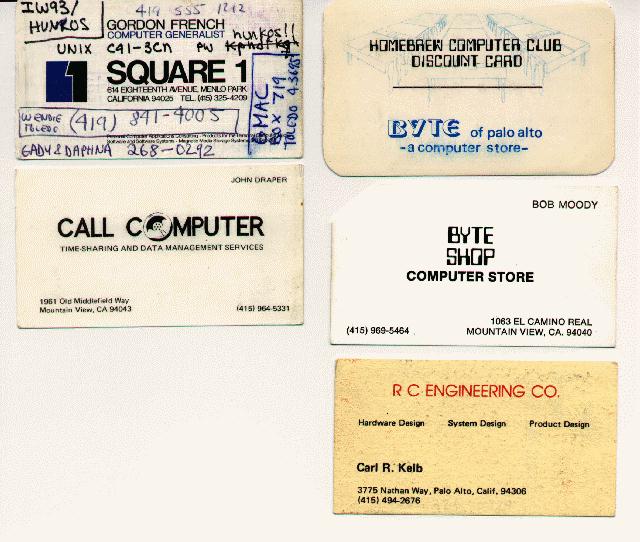
1973 The Home Brew Club
Posted on a bulletin board in the Palo Alto High School terminal room, (in the Palo Alto High School
math-science office) was a notice that a computer group meeting would be held at the home of
Gordon French, in his garage. This was to be
the first meeting of the famous "home brew club"
As the club grew People like
Bill Gates (Microsoft) and Steve Jobbs (Apple) attended and spawned the now
famous computer corporations. This has been well documented in the book "Accidental Empires"
by Robert X Cringely, and on the television series shown in 1996 called the
"Triumph of the Nerds".
A great site jotting down the memories of a "Home Brew Club" member can be
found here>>.
top>>
1973 CP/M
Gary Kildall writes a simple operating system in his PL/M language. He
calls it CP/M (Control Program/Monitor).
(Control Program for Microcomputer)
1975 MITS Altair
 MITS (Micro Instrumentation and Telemetry Systems)
was was founded in 1968 by Ed Roberts and two friends. MITS first made radio
control devices, then calculators.
The MITS Altair was the first 8080 based kit microcomputer.
It was first introduced in the January, 1975 issue of Popular
Electronics magazine as a construction project. The reaction to the Altair was
un-expected by either the magazine or by MITS who designed it. Although not the
first available microcomputer , it was the start of the industry.
More here>>
and
here>>.
The Altair 8800 was also the first computer using a built-in Basic interpreter
written by two people working at MITS and called Bill Gates and Paul
Allen. (see below)
MITS (Micro Instrumentation and Telemetry Systems)
was was founded in 1968 by Ed Roberts and two friends. MITS first made radio
control devices, then calculators.
The MITS Altair was the first 8080 based kit microcomputer.
It was first introduced in the January, 1975 issue of Popular
Electronics magazine as a construction project. The reaction to the Altair was
un-expected by either the magazine or by MITS who designed it. Although not the
first available microcomputer , it was the start of the industry.
More here>>
and
here>>.
The Altair 8800 was also the first computer using a built-in Basic interpreter
written by two people working at MITS and called Bill Gates and Paul
Allen. (see below)
The key to the whole computer project was the
microprocessor chip itself, the 8080 from Intel. The Altair was offered as a complete kit, not just a list of parts to buy in
order to make a computer. In those days it was almost impossible for anyone
outside Silicon Valley, California, where the chips and other parts were made,
to find the components necessary to build a computer.
After its picture appeared on the cover of "Popular Electronics", it was assured its success.
1975 Bill Gates forms Microsoft
in April 1975, Bill Gates and Paul Allen founded Microsoft (which was to achieve a certain notoriety over
the coming years). In July of that year, MITS announced the availability of BASIC 2.0 on the Altair 8800.
This BASIC interpreter, which was written by Gates and Allen, was the first reasonably high-level computer
language program to be made available on a home computer. MITS sold 2,000 systems that year, which
certainly made Ed Roberts of Altair fame, very happy.
top>>
1975 Imsai 8080
The Imsai 8080 developed by IMS Associates, was
designed to use the same bus structure as the Altair 8800 with interchangeable
circuit boards. The Imsai 8080 however was much better built, had a more
powerful power supply, and front panel. It supplanted the Altair A model as the
standard S-100 Bus computer. The Imsai was the first for a complete line of
micros built by this company.
1976 Apple is formed
 Steven Wozniak and Steven Jobs had been friends in high school. They had
both been interested in electronics, and both had been perceived as
outsiders. They kept in touch after graduation, and both ended up dropping
out of school and getting jobs working for companies in Silicon Valley. (Wozniak
for Hewlett-Packard, Jobs for Atari)
Steven Wozniak and Steven Jobs had been friends in high school. They had
both been interested in electronics, and both had been perceived as
outsiders. They kept in touch after graduation, and both ended up dropping
out of school and getting jobs working for companies in Silicon Valley. (Wozniak
for Hewlett-Packard, Jobs for Atari)
Wozniak had been dabbling in
computer-design for some time when, in 1976, he designed what would become
the Apple I.
The Apple I was Steven Wozniak's first contribution to the personal computer
field. It was designed over a period of years, and was only built in printed
circuit-board form when Steve Jobs insisted it could be sold. Jobs, who had an eye for the future, insisted that he and
Wozniak try to sell the machine, and on April 1, 1976, Apple Computer was
born. It debuted in
April 1976 at the Homebrew Computer Club in Palo Alto, but few took it
seriously. The Apple I was based on the MOStek 6502 chip, whereas most other
"kit" computers were built from the Intel 8080. The Apple I was sold through
several small retailers, and included only the circuit board. A tape-interface
was sold separately, but you had to build the case. The Apple I's initial cost
was $666.66 see the advert here>>
also visit
Apple-History and also
Apple II History for all the information you could want on the Apple
computer.
top>>
1976 The Floppy Disk
In 1976 floppy drives were introduced in the 5.25
inch size by Shugart Associates. In a cooperative effort, Dysan Corporation
manufactured the matching 5.25 inch diskettes. Originally these drives were
available in only a single-sided low density format, and like the first 8 inch
models, stored less than 100 kilobytes. Later they received many of the same
enhancements made to the 8 inch models, and eventually 5.25 inch floppy drives
settled at a double-sided, "double density" formatted capacity of about 1.2
megabytes. This drive was used in the IBM 'AT' personal computer. It is also the
popular 5.25 inch model still with us today. A history of the floppy disk can
be found here>>
top>>
1977 MITS Altair sold
Though Altair maintained its lead as the primary computer seller, in 1976 MITS was
in trouble. The company had grown too big too fast and had too many projects
going on at the same time. Computers hardware quality was not good, products
were failing, and customers were complaining. Communication within the company
began to deteriorate.
Paul Allen and Bill Gates both left MITS to develop their
own company, Micro-Soft. Many manufacturers copied the Altair concept and one's
heard about modern easy-to-use computers called Apple or Commodore.
In
May 1977, Ed Roberts decided to sell MITS to Pertec for $6 million, a larger
company that manufactured disks and tape drives for minicomputers and mainframe
computers. Sadly, the sale of the company did not solve problems. The Pertec
management team came in with new ideas and a new way of working and MITS people
began to leave the company. Even Roberts became fed up with Pertec and left too.
Pertec continued making Altairs small business System for about a year after the
acquisition, moving away from the "Hobbyist Computer" image of the 8800.
Computer production ceased definitively in July 1978.
Thanks to
oldcomputers.com for this article.
top>>
 The ADM-3A was one of the first affordable serial display
terminals manufactured by Lear-Siegler Inc. of Anaheim California.
(Anaheim Division, Manufacturing)
The ADM-3A superseded the ADM-3 which only displayed upper-case
letters. The 3A version did not display upper-case letters, but an optional chip
set allows them to be displayed.
The ADM-3A was one of the first affordable serial display
terminals manufactured by Lear-Siegler Inc. of Anaheim California.
(Anaheim Division, Manufacturing)
The ADM-3A superseded the ADM-3 which only displayed upper-case
letters. The 3A version did not display upper-case letters, but an optional chip
set allows them to be displayed.
A kit version was released which could be ordered
with a white, green, or amber tube background colour.
The ADM-3A was very successful due to its
reliability and low price.
The setup of this 'Dumb machine' (as Lear
Siegler advertised) was done using... 32 dip switches (!) located at the left of
the keyboard. Among them, 11 was used for the communication rate (from 75 to
19200 bauds), others for parity, display configuration, character set, etc.
Thanks to
oldcomputers.com for this article.
top>>
1977 Xerox introduces the Laser
Xerox started work on laser printers back in 1969. By 1977 Xerox was selling
the 9700 (a 120 page-per-minute, full-duplex monster) for about $350,000. Canon
brought out the first desktop laser printer, called the LBP-10 in or around
1982. In 1983 Canon started giving private showings of the LBP-CX to key
companies in California such as Apple, Diablo and HP. Canon was looking for
strong marketing partners who were in the computer business. Canon U.S.A. was
very strong in cameras and office products, copiers for example, but didn't have
the connections needed to sell effectively into the data processing world.
Evidently, one of Canon's first stops was the Diablo Systems subsidiary of Xerox
Corporation. Diablo was the logical partner because it had the largest market
share for letter-quality daisywheel printers and the marketing managers had
recently shown their willingness to put the Diablo name on products from other
manufacturers. Diablo had just done several OEM deals with Honeywell for dot
matrix printers and with Sharp for color ink jet printers. Canon really wanted
Xerox as a partner, and Xerox was the first company offered the opportunity to
market the CX engine with Canon's controller. A great site developing the
history of the laser can
be found here>>
top>>
1977 Computerland launch stores
William Millard is
president of the IMSAI company in 1976 and sells ready to order computer
kits based on the Intel 8080 microprocessor by mail. Sales are good and Millard
wants to move beyond kits and sell a pre-assembled computer for better profits.
To help sales, he decides to create chain stores specialized in computer sales
and mostly IMSAI 8080's.
In February of 1977, the first Computer
Shack store opens in Morristown, New Jersey and in March the first advert
appears.
After litigation from Radio Shack, the chain is renamed
ComputerLand. In August 1977, 14 stores are opened, 23 in November and
several hundreds eventually open worldwide in the following years.
Unfortunately, Millard then makes the big mistake of announcing a new version
of the IMSAI computer before it is ready at all.
Large numbers of customers return their IMSAI computers, sales collapse and ComputerLand is
almost bankrupt.
Fortunately, at the same time Apple is seeking distributors
to increase sales of its Apple II. Success follows and profits rise each year and reach one
billion dollars in 1984.
After that extraordinary year, trouble comes,
resellers rebel and create an association to defend their interests, and several
employees sue Millard for broken promises. The spirit of the company gone,
Millard sells ComputerLand for 200 million dollars and leaves for good to an
island in the Pacific Ocean. ComputerLand still exists as a company, and
nowadays has about 200 resellers in the US.
Thanks to
oldcomputers.com for this article.
1977 Apple II Launched
 After a
successful showing of the sleek new Apple II at the 1977 West Coast Computer Fair it went on sale
later that year.
Steve Jobbs wanted this machine to be more than just an enthusiasts toy but rather a computer you would want to
work with. Also to enhance the new machine a new logo was designed for the
company (left) and the image was so well received that the Apple II launch
sold over 300 machines (over 100 more than the total Apple 1 sales). See
this site for a full
history.
After a
successful showing of the sleek new Apple II at the 1977 West Coast Computer Fair it went on sale
later that year.
Steve Jobbs wanted this machine to be more than just an enthusiasts toy but rather a computer you would want to
work with. Also to enhance the new machine a new logo was designed for the
company (left) and the image was so well received that the Apple II launch
sold over 300 machines (over 100 more than the total Apple 1 sales). See
this site for a full
history.
1977 Z80-A chip is produced
At its new manufacturing facilities in Cupertino, Zilog announced the
manufacture of the Z80-A in February 24 1977. The Z80-A has a standard clock
rate of 4 Mhz. which is made possible by a new technology developped by Zilog.
There was a ceramic package and a plastic version.
According to Zilog, the Z80-A is considered to be the fastest standard
microprocessor. Its instructions cycle is 1 µs, and its throughput is 60% above
the one of the Z80.
From now, it becomes available in production
quantities for computer manufacturers. The standard Z80 at a clock rate of 2.5
Mhz. was still continued at a reduced price.
Thanks to
oldcomputers.com for this article.
top>>
1977 Commodore Pet launched
 The PET 2001 (Personal Electronic Transactor) was the first computer unit ready
to plug in to a mains supply and use. This concept, added to a futuristic
design, caused an enormous sensation at The 1977 Summer Consumer Electronics
Show in Chicago. In fact, a first PET model was presented during the January
CES, but it never worked properly.
The PET 2001 (Personal Electronic Transactor) was the first computer unit ready
to plug in to a mains supply and use. This concept, added to a futuristic
design, caused an enormous sensation at The 1977 Summer Consumer Electronics
Show in Chicago. In fact, a first PET model was presented during the January
CES, but it never worked properly.
The PET was the first computer sold by
Jack Tramiel. A legend says that, one day, Chuck Peddle, the designer of the
6502 microprocessor, accosted him in a corridor and asked him to forget hand
held calculators and think about a desktop computer. Tramiel said, "Build it"
and Chuck built the PET computer based on the 6502 microprocessor!
The PET name was only until the 4000 series as Philips, the owner of
the registered PET name, instructed Commodore to use a different name.
Commodore chose to use the CBM logo for the later systems.
The PET system was the father of a large family of PET/CBM computers
including the 2000, 4000, 8000 series, then the 500, 600 and 700 series in 1983
Thanks to
oldcomputers.com for this article
and picture.
top>>
1978 VisiCalc Spreadsheet is born
Dan Bricklin was preparing a spread sheet analysis for a Harvard Business School
"case study" report and had two alternatives:
1) do it by hand or
2) use a
time-sharing mainframe program.
Bricklin thought there must be a better
way. He wanted a program where people could visualize the spreadsheet as they
created it.
By the fall of 1978, Bricklin had programmed the first working prototype of his
concept in integer basic. The program helped users input and manipulate a matrix
of five columns and 20 rows.
The first version was not very "powerful" so
Bricklin recruited an MIT acquaintance Bob Frankston
to improve and expand the program. Bricklin calls Frankston the "co-creator" of
the electronic spreadsheet.
Frankston created the production code with faster
speed, better arithmetic, and scrolling. He also expanded the program and
"packed the code into a mere 20k of machine memory, making it both powerful and
practical enough to be run on a microcomputer".
 During the fall of 1978, Daniel Fylstra, founding Associate
Editor of Byte Magazine, joined Bricklin and Frankston in developing VisiCalc.
Fylstra was "marketing-oriented" and suggested that the product would be viable if it could run on an Apple
micro-computer. Bricklin and Frankston formed Software Arts Corporation on
January 2, 1979.
During the fall of 1978, Daniel Fylstra, founding Associate
Editor of Byte Magazine, joined Bricklin and Frankston in developing VisiCalc.
Fylstra was "marketing-oriented" and suggested that the product would be viable if it could run on an Apple
micro-computer. Bricklin and Frankston formed Software Arts Corporation on
January 2, 1979.
In May 1979, Fylstra and his firm Personal Software (later
renamed VisiCorp) began marketing "VisiCalc" with a teaser ad in Byte Magazine.
The name "VisiCalc" is a compressed form of the phrase "visible calculator" (see
email from Frankston, 4/15/1999b).
VisiCalc became an almost instant success and provided many
business people with an incentive to purchase a personal computer or an H-P 85
or 87 calculator from Hewlett-Packard.
About 1 million
copies of the spreadsheet program were sold during VisiCalc's product lifetime.
Dan Bricklin has his version of the history of Software Arts and VisiCalc on the
web at www.bricklin.com/history/sai.htm.
Bricklin includes early ads and reviews and pictures of the VisiCalc packaging
and screenshots.
What came after VisiCalc?
The market for electronic spreadsheet software was growing
rapidly in the early 1980s and VisiCalc stakeholders were slow to respond to the
introduction of the IBM PC that used an Intel computer chip. Beginning in
September 1983, legal conflicts between VisiCorp and Software Arts distracted
the VisiCalc developers, Bricklin and Frankston. During this period, Mitch Kapor developed Lotus
and his spreadsheet program quickly became the new industry spreadsheet
standard.
Thank you to the
DSS Resources
history pages for this excellent article.
top>>
1978 The first spam message
The very first spam message was sent in 1978 when the internet was known as Arpanet.
By 1978 Arpanet had been operating for about nine years and was letting lots of
people at universities and government bodies swap e-mail.
On 3 May a marketing executive at Digital Equipment Corporation, a leading
maker of minicomputers, decided to send all West Coast Arpanet users a message
about an open day that would show off its new range of machines.
The message generated huge controversy within the Arpanet community, partly
because it was so poorly written and because it clearly broke the nascent
network's acceptable use policy. This turned out to be the first unsolicited e-mail later termed SPAM.
top>>
1979 Ashton Tate releases Dbase
DBASE may be traced back to the mid 1960's in the form of a system called RETRIEVE,
which was marketed by Tymshare Corporation. RETRIEVE was used by Jet Propulsion Laboratory
of Pasadena,Calif. In the late 60’s Jeb Long, a new programmer at JPL, was assigned the task
of writing a program which would perform the same functions as RETRIEVE. The new system
developed was JPLDIS. This system is still used today on many UNIVAC 1100 class computers.
In the late 1970’s Wayne Ratliff, who worked at JPL and was a friend of Jeb Long, began
to develop a micro database system which for the user was very much like JPLDIS. It has been
reported that the original micro database system was developed to aid in winning football pools.
The new system was named VULCAN.
VULCAN had its ups and downs and by 1980 was in what seemed to be a permanent down state.
Then an entrepreneur name George Tate found the product worth while, renamed it dBASE II and
formed a new company, Ashton-Tate to market the new product.
dBASE went through many upgrades and versions and was subsequently purchased by
Borland. Currently there are many versions available the newest being DBASE 5.5 for Windows.
top>>
1979
Apple Computer releases DOS 3.2.
Apple DOS 3 and 3.1 had a few problems. When the Apple II Plus
(with the Auto start ROM built into the machine) was released, DOS needed to be updated to handle the changes.
DOS 3.2, released in February 1979, contained several modifications, but retained 90 percent of the
basic structure of DOS 3.1. One interesting change made to plan for the future was a doubling of
the number of possible file types.
See this excellent
article and the history of DOS
top>>